
Published on: May 14, 2025
Updated on: June 23, 2025
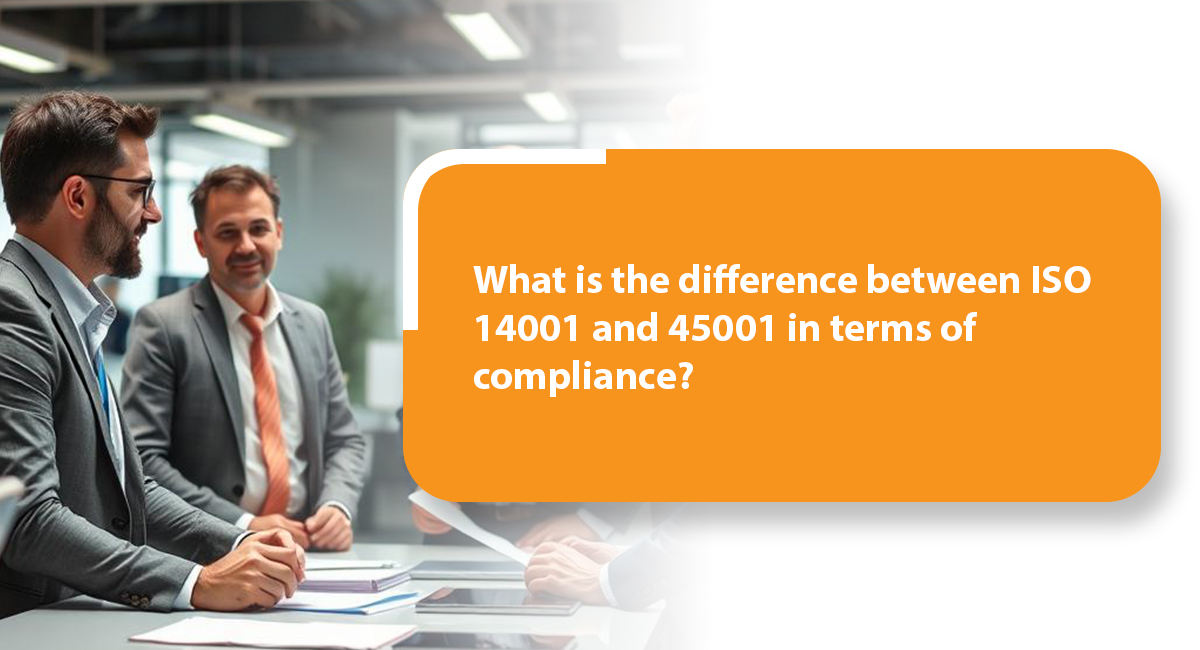
To answer this question, one must first acknowledge the fundamental aim of each benchmark. ISO 14001 is the global standard for environmental sustainability management. ISO 45001 is known for offering help with occupational health and safety management. For compliance management, each standard offers comprehensive support for a special business purpose.
ISO 14001 and ISO 45001 are both international standards that outline requirements for management systems, but they focus on different areas. ISO 14001 addresses Environmental Management Systems (EMS), guiding organisations in managing their environmental responsibilities. ISO 45001 pertains to Occupational Health and Safety Management Systems, focusing on ensuring workplace safety and the well-being of employees. In terms of compliance, both standards require organizations to identify, understand, and adhere to relevant legal and other obligations within their respective scopes. However, the nature of these compliance obligations differs due to their distinct focuses. The following blog highlights the prime aspects of each standard that highlight the difference in terms of meeting compliance. It has offered some fundamental insights towards each.
ISO 14001: Environmental Compliance – Business firms must identify and have access to environmental laws and regulations applicable to their activities, products, and services. This includes understanding how these legal requirements apply and ensuring the company meets them. Regular evaluations are necessary to assess compliance status and address any non-conformities. For instance, a manufacturing company would need to comply with regulations on emissions, waste management, and resource usage.
ISO 45001: Occupational Health and Safety Compliance – Companies must identify and have access to legal and other requirements related to health and safety hazards that may occur frequently. This involves determining how these obligations apply to the organization and ensuring they are integrated into the OHSMS. Regular evaluations of compliance are conducted to verify adherence and implement corrective actions when necessary. For example, a construction company must comply with regulations concerning worker safety, equipment usage, and hazard communication.
Focus Areas: ISO 14001 centers on environmental aspects and impacts, requiring compliance with environmental laws. In contrast, ISO 45001 focuses on occupational health and safety risks, necessitating compliance with workplace safety regulations.
Risk Assessment: While both standards emphasize risk assessment, ISO 14001 deals with environmental risks pollution), whereas ISO 45001 addresses risks related to worker health and safety (injury prevention).
Stakeholder Considerations: ISO 14001 requires consideration of environmental stakeholders, such as regulatory bodies and the community. ISO 45001 emphasises stakeholders like employees, contractors, and occupational health agencies. Despite these differences, both standards share a common framework, facilitating their integration into a unified management system. This integration allows organisations to efficiently manage compliance obligations across environmental and occupational health and safety domains.
To find the right professional support for implementing an ISO quality management system standard and internal audit requirement, contact us at ComplianceHelp. We are the premier site for achieving any ISO certification in Australia. Our customised solutions for ISO and other global certifications are ready to make this seemingly exhausting accreditation process comfortable and completed on time. From basic consultation to audit and analysis, we will cover everything. Get our help answering any questions you have regarding the clauses of any management system standard you require.







Get connected with us on social networks!


